Top 10 Drip Irrigation Kits
We may earn a commission for purchases made using our links. Please see our disclosure for more details.
Dragging a hose around the yard gets old quickly, especially when you have raised beds, containers, or vegetables that need regular watering. A good drip irrigation kit takes much of that daily work off your plate while putting water where plants actually need it—around their roots. The catch is that kits vary a lot. Some are wonderfully simple; others arrive with a mountain of tiny fittings and vague instructions. We compared tubing, emitter design, coverage, installation, expandability, brand reputation, and current customer feedback to narrow the field to ten options worth considering.
Our Top Picks
| Product | Best For | Key Feature | Rating | Read More |
| CARPATHEN 100FT Drip Irrigation Kit | Best Overall | 30 adjustable emitters | ★★★★⯪ | Read review |
| Rain Bird LNDDRIPKIT | Best Brand-Name Kit | Pressure-compensating emitters | ★★★★⯪ | Read review |
| MIXC 230FT Quick-Connect Kit | Beginners | Fast-lock connections | ★★★★⯪ | Read review |
| Bonviee 230FT Drip Irrigation Kit | Large Layouts | 230 ft of tubing | ★★★★⯪ | Read review |
| Rain Bird DRIPKITBAG | Expansion | 102-piece system | ★★★★★ | Read review |
| DIG GE200 | Large Gardens | Drip + micro sprinklers | ★★★★⯪ | Read review |
| Garden In Minutes 4×8 Garden Grid | Raised Beds | Preassembled grid | ★★★★★ | Read review |
| Vego Garden Irrigation Kit | Metal Raised Beds | Bed-focused layout | ★★★★★ | Read review |
| Rain Bird GARDENKIT | Vegetable Beds | Raised-bed design | ★★★★★ | Read review |
| HIRALIY 100FT Drip Irrigation Kit | Large DIY Garden Layouts | 100 ft tubing with quick-connect system | ★★★★⯪ | Read review |
1. CARPATHEN 100FT Drip Irrigation Kit — Best Overall

CARPATHEN strikes a nice balance between DIY flexibility and not making installation unnecessarily complicated. You get 100 feet of tubing split between mainline and distribution tubing, plus 30 adjustable emitters for individual plants or wider watering areas. Current marketplace data puts it around the mid-4-star range with well over 1,000 reviews.
Key features: 100 ft total tubing, 30 emitters, adjustable vortex and spray heads, UV-resistant tubing, and compatibility with roughly 20–45 PSI.
Pros
- Good mix of drip and spray emitters
- Plenty of positive customer feedback
- Adjustable flow for mixed plantings
- Useful for raised beds, pots, and garden rows
Cons
- Main tubing can kink around tight corners
- Large gardens may need additional mainline
Best for: Gardeners wanting one flexible kit for several different planting areas.
Why I recommend it: It gives you enough flexibility to build a useful system without immediately shopping for a pile of extra components.
2. Rain Bird LNDDRIPKIT — Best Brand-Name Starter Kit

If you would rather build around a widely available irrigation ecosystem, Rain Bird makes a lot of sense. The LNDDRIPKIT uses pressure-compensating watering components and standard irrigation parts, making future repairs and expansion less intimidating.
The kit includes a main supply line, distribution tubing, multiple watering-device styles, fittings, and pressure-control components.
Pros
- Established irrigation brand
- Pressure-compensating emitters
- Replacement parts are easier to source
- Versatile enough for landscaping and gardens
Cons
- More involved than ultra-simple quick-connect kits
- Initial layout takes some planning
Best for: Homeowners who expect to expand or maintain their system for several seasons.
Why I recommend it: The real advantage isn’t flashy accessories. It’s the mature parts ecosystem and straightforward expandability.
3. MIXC 230FT Quick-Connect Drip Irrigation Kit — Best for Beginners

Traditional barbed fittings can be surprisingly stubborn. MIXC’s quick-connect design removes much of that frustration.
With roughly 230 feet of combined tubing and capacity for dozens of watering points, this kit suits gardens where pots or beds are spread across a decent area. Multiple adjustable nozzle styles also let you mix targeted dripping with broader spray.
Pros
- Quick-connect installation
- Generous tubing length
- Several emitter styles
- Works well for custom layouts
Cons
- Pressure management matters on long runs
- Instructions could be clearer
Best for: First-time drip-irrigation users.
Why I recommend it: You can concentrate on where the water needs to go rather than fighting every connector.
4. Bonviee 230FT Drip Irrigation System — Best for Large Layouts

Bonviee is another strong choice when coverage matters. Its 230-foot kit combines a larger mainline with plenty of smaller distribution tubing and adjustable emitters.
The push-to-connect fittings are particularly helpful if you’re watering several raised beds or a mixture of beds and containers.
Pros
- Lots of tubing for the money
- Tool-free connections
- Adjustable watering patterns
- Timer compatible
Cons
- Tubing can feel stiff in cooler weather
- Very long runs can experience pressure loss
Best for: Multiple raised beds, vegetable gardens, and greenhouses.
Why I recommend it: The extra tubing makes a genuine difference when your beds aren’t conveniently grouped around one faucet.
5. Rain Bird DRIPKITBAG — Best for Expansion

Already have some irrigation installed? The DRIPKITBAG is the one I’d look at before buying another complete beginner kit.
It includes around 100 feet of 1/4-inch tubing plus a large assortment of emitters, connectors, plugs, stakes, and installation accessories. Pressure-compensating emitters help keep watering more consistent.
Pros
- Large assortment of components
- Excellent for repairs and expansion
- Reusable storage bag
- Standard Rain Bird parts
Cons
- Not the most complete choice for a totally new installation
- No automatic timer
Best for: Expanding or repairing an existing drip system.
Why I recommend it: It’s essentially a useful irrigation parts box rather than a one-layout-only kit.
6. DIG GE200 Drip & Micro Sprinkler Kit — Best for Large Gardens

Most kits in this roundup target compact home gardens. DIG’s GE200 plays in a different league.
It includes 200 feet of 1/2-inch tubing, 50 feet of micro tubing, 20 pressure-compensating drippers, and 11 micro-sprayer assemblies. DIG rates the kit for coverage up to approximately 700 square feet, with expansion possible beyond that.
Pros
- Excellent coverage
- Combines drippers and micro sprayers
- Includes pressure regulator and backflow preventer
- Expandable design
Cons
- More setup work
- Overkill for a few patio pots
Best for: Landscapes, shrubs, flowerbeds, slopes, and larger vegetable gardens.
Why I recommend it: Few starter kits give you this much freedom to combine point-source dripping and low-flow spraying.
7. Garden In Minutes 4×8 Garden Grid — Best Premium Raised-Bed System

This one approaches watering differently. Instead of running individual emitters to plants, the Garden Grid creates evenly spaced watering sections across a raised bed.
Setup is unusually quick because much of the system arrives preassembled. The grid also doubles as a planting-spacing guide, which square-foot gardeners may appreciate.
Pros
- Very quick installation
- Even coverage throughout a bed
- Doubles as planting guide
- Durable, reusable construction
Cons
- Significantly more expensive than basic tubing kits
- Less customizable for irregular beds
Best for: 4×8 raised beds and square-foot gardening.
Why I recommend it: If you’d rather pay more upfront to avoid cutting dozens of little tubing sections, this is one of the neatest solutions available.
8. Vego Garden Irrigation Kit — Best for Modular Raised Beds

Vego’s system is aimed squarely at raised-bed gardeners. Instead of trying to be a universal landscape kit, it provides an organized watering layout designed around modular beds.
That narrower purpose is actually its strength. Installation looks cleaner than many improvised drip systems, and current owner feedback for the irrigation kit is very strong.
Pros
- Excellent fit for raised beds
- Clean installation
- Available in different sizes
- Strong owner ratings
Cons
- Costs more than budget DIY kits
- Makes less sense for scattered containers
Best for: Gardeners using metal or modular raised beds.
Why I recommend it: A purpose-built bed system can save a surprising amount of cutting, measuring, and troubleshooting.
9. Rain Bird GARDENKIT — Best for Vegetable Beds

Rain Bird’s GARDENKIT is designed specifically around raised-bed watering rather than general landscaping. That makes it easier to create predictable watering coverage around vegetables, herbs, and closely planted crops.
The system combines standard Rain Bird components with multiple watering points and pressure regulation.
Pros
- Designed around raised beds
- Reputable irrigation brand
- Standard replacement components
- Good choice for vegetables
Cons
- Smaller review base than several picks above
- May require extra tubing for multiple distant beds
Best for: Vegetable and herb beds.
Why I recommend it: You get the convenience of a bed-focused kit without locking yourself into an obscure parts system.
10. HIRALIY 100FT Drip Irrigation Kit — Best for Large DIY Layouts

HIRALIY’s 100FT Drip Irrigation Kit gives you plenty of tubing to work with when your plants are spread across several raised beds, vegetable rows, or container groups. The quick-connect fittings also make it easier to assemble and rearrange the system without wrestling with every connection.
Adjustable emitters let you control the amount of water delivered to different plants, which is handy when your garden contains crops with different watering needs. With 200 feet of tubing, there’s also enough flexibility for more ambitious backyard layouts.
Key features: 100 ft total tubing, quick-connect fittings, adjustable drip emitters, customizable watering layout.
Pros
- Generous amount of tubing
- Quick-connect fittings simplify installation
- Adjustable water flow
- Flexible enough for different garden layouts
Cons
- Longer runs require careful pressure management
- Larger installations take some planning
Best for: Gardeners watering multiple raised beds, vegetable rows, flower beds, or containers.
Why I recommend it: It offers a useful combination of generous coverage and easy connections, making it a practical choice when a smaller starter kit simply doesn’t provide enough tubing.
How to Choose the Best Drip Irrigation Kits
Don’t choose based on tubing length alone. A 200-foot kit with a tiny mainline can perform worse in a large garden than a shorter system designed to maintain adequate pressure.
Start by measuring the distance from your faucet to the garden and then the distance between planting areas. For several beds, look for a larger main supply tube feeding shorter 1/4-inch branches.
Emitter type matters too. Adjustable drippers work well for mixed plants because you can alter output individually. Pressure-compensating emitters are useful when you want more consistent flow across longer lines, while pre-spaced dripline makes sense for closely planted rows.
Also check whether the kit includes a pressure regulator and filter. Household water pressure can be too high for small irrigation fittings, while sediment can eventually clog tiny emitter passages.
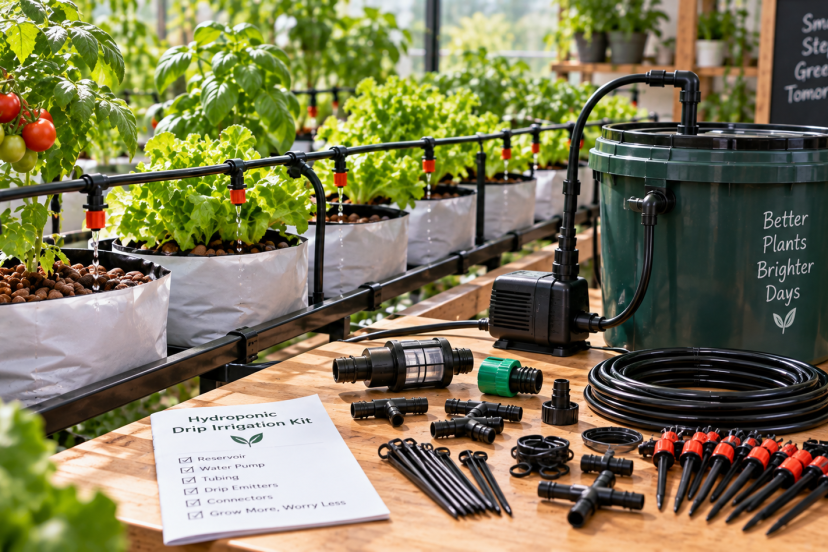
For hydroponic drip systems rather than outdoor faucet-fed gardens, pump selection becomes equally important. This guide to sizing a hydroponics water pump explains how flow, head height, and system type affect pump requirements.
If you’re working with small indoor crops, you may also find the guide to growing hydroponic microgreens at home useful when planning a compact watering setup.
Final Thoughts
The best drip irrigation kits aren’t necessarily the ones with the most pieces—they’re the ones that match the way your garden is actually laid out. For most home gardeners, the CARPATHEN 100FT Drip Irrigation Kit offers the strongest mix of flexibility, manageable installation, and adjustable watering. Choose MIXC or Bonviee when easy connections and longer tubing runs matter more, Rain Bird when you value readily available replacement parts, or a dedicated raised-bed system such as Garden Grid when you want a tidy, repeatable setup. Measure first, keep individual branch lines reasonable, regulate pressure, and you’ll end up with a system that saves far more time than it takes to install.
FAQs
What is the best drip irrigation kit for beginners?
The CARPATHEN 100FT Drip Irrigation Kit is a strong all-around beginner choice because it combines manageable tubing lengths with adjustable emitters. MIXC’s quick-connect system is another good option if easy assembly is your biggest priority.
How long should I run a drip irrigation system?
There isn’t one correct runtime. Soil type, emitter flow rate, weather, plant size, and root depth all matter. Check the soil after watering and adjust your schedule so moisture reaches the active root zone without leaving the ground waterlogged.
Do drip irrigation kits need a pressure regulator?
Many systems benefit from one. Household faucets can supply more pressure than small drip fittings and emitters are designed to handle. A properly matched regulator reduces leaks, popped connections, and inconsistent flow.
Can I connect a drip irrigation kit to a timer?
Yes. Many faucet-fed drip systems can be paired with a compatible hose-end timer. This is particularly handy during hot weather or vacations, but inspect the system periodically for clogged emitters and leaks rather than treating it as completely maintenance-free.
Is 1/4-inch or 1/2-inch tubing better for drip irrigation?
They serve different jobs. 1/2-inch tubing generally works better as the main supply line because it carries more water with less pressure loss. 1/4-inch tubing is useful for shorter branches running from that mainline to individual plants or emitters.