Top 10 Humidity Controller
We may earn a commission for purchases made using our links. Please see our disclosure for more details.
Maintaining steady humidity can make the difference between healthy plants and a grow space filled with mold, dry leaves, or stalled growth. A reliable humidity controller monitors relative humidity and automatically activates connected equipment when conditions move outside your chosen range.
This guide covers straightforward plug-in humidistats, Wi-Fi models, complete environmental controllers, and fan systems with built-in climate management. Whether you are tending seedlings, mushrooms, hydroponic vegetables, or a full indoor garden, these picks can help you create a more stable environment with less daily adjustment.
Our Top Picks
| Product | Best For | Key Feature | Rating | Read More |
| Inkbird IHC-200 | Best overall | Dual-stage humidity control | ★★★★⯪ | Read review |
| Inkbird Wi-Fi IHC-200 | Remote monitoring | App-based adjustments | ★★★★⯪ | Read review |
| AC Infinity Controller 69 Pro | Grow tents | VPD and climate programs | ★★★★⯪ | Read review |
| Inkbird ITC-608T | Temperature and humidity | Two-in-one environmental control | ★★★★⯪ | Read review |
| VIVOSUN Dual-Stage Humidity Controller | Two-way humidity control | Dual outlets with LED displays and safety alarms | ★★★★⯪ | Read review |
| DIGITEN DHC101 | Budget pick | Simple plug-and-play design | ★★★★⯪ | Read review |
| AC Infinity Controller 79 Pro | Standard outlet devices | Two independently programmed outlets | ★★★★⯪ | Read review |
| Pymeter Controller | Mixed equipment | Separate temperature and humidity outlets | ★★★★⯪ | Read review |
| AC Infinity CLOUDLINE T4 | Small grow tents | Fan and controller package | ★★★★⯪ | Read review |
| AC Infinity CLOUDLINE T6 | Larger grow tents | High-capacity smart ventilation | ★★★★⯪ | Read review |
Top 10 Humidity Controller Reviews
1. Inkbird IHC-200 Humidity Controller

The Inkbird IHC-200 Humidity Controller uses two pre-wired outlets to manage humidifying and dehumidifying equipment automatically. Its sensor measures relative humidity across a range of 5% to 99% RH.
Adjustable differential settings help prevent equipment from cycling too frequently. The controller also offers sensor calibration and high- and low-humidity alarms for added protection.
Pros: Dual-stage operation, two pre-wired outlets, adjustable differential, calibration, and humidity alarms.
Cons: No Wi-Fi connectivity, and the button controls require some initial setup.
Best for: Grow tents, greenhouses, mushroom rooms, and other spaces requiring two-way humidity control.
Why we recommend it: It provides dependable, straightforward control without requiring proprietary equipment or a mobile app.
2. Inkbird Wi-Fi IHC-200 Humidity Controller
The Inkbird Wi-Fi IHC-200 combines dual-outlet humidity management with remote monitoring through the Inkbird app. You can check conditions, modify settings, and receive alerts without entering the grow room.
The controller can operate a humidifier and dehumidifier independently. It also stores humidity records, making it easier to identify environmental changes over time.
Pros: Remote monitoring, two controlled outlets, app notifications, humidity records, and adjustable settings.
Cons: Requires a 2.4 GHz Wi-Fi network, and app pairing may take additional time.
Best for: Growers who want to monitor humidity while away from their indoor garden.
Why we recommend it: It adds useful remote controls to the reliable dual-stage design of the standard IHC-200.
3. AC Infinity Controller 69 Pro

The AC Infinity Controller 69 Pro is a smart environmental controller built for compatible AC Infinity UIS equipment. It can coordinate fans, lights, humidifiers, and other devices through four control ports.
Users can create programs based on humidity, temperature, VPD, schedules, timers, and cycles. Wi-Fi and Bluetooth connectivity also provide remote access, alerts, and historical climate information.
Pros: Four UIS ports, Wi-Fi and Bluetooth, VPD programming, climate records, and advanced automation.
Cons: Standard outlet equipment may require an adapter, and it offers the best value within the AC Infinity ecosystem.
Best for: Automated grow tents using several compatible AC Infinity devices.
Why we recommend it: Its flexible programming allows multiple devices to work together instead of operating through separate controllers.
4. Inkbird ITC-608T Temperature and Humidity Controller
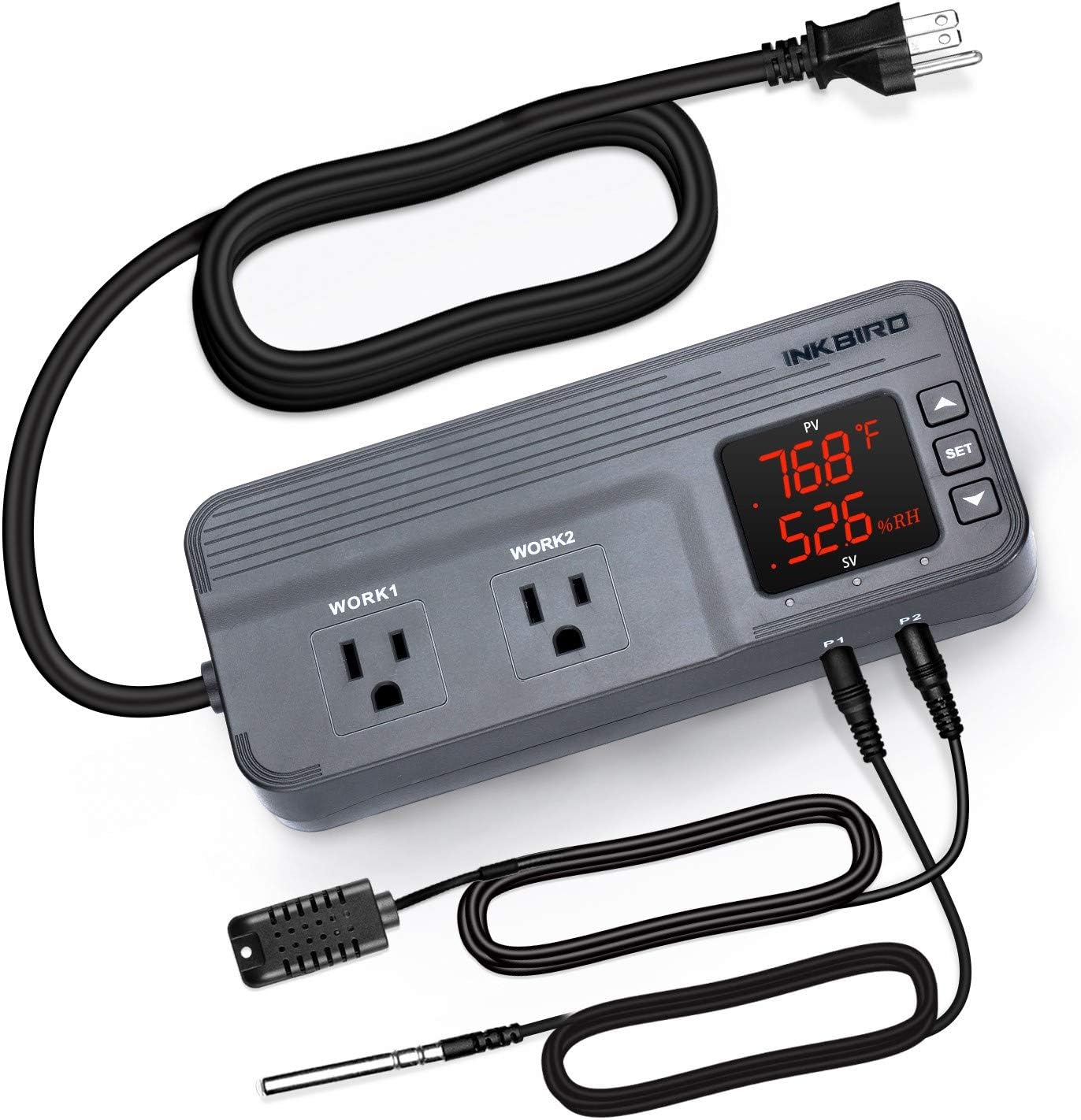
The Inkbird ITC-608T controls temperature and humidity from one pre-wired unit. Depending on the connected sensors, its outlets can operate heating, cooling, humidifying, or dehumidifying equipment.
The controller supports loads up to 15 amps and 1,800 watts at 120 volts. It also includes calibration, alarms, compressor-delay protection, and automatic storage of programmed settings.
Pros: Temperature and humidity management, high load capacity, calibration, alarms, and compressor protection.
Cons: Programming is more involved than on a humidity-only controller, and functions depend on the connected sensor.
Best for: Greenhouses and grow rooms that require broader environmental management.
Why we recommend it: It replaces separate temperature and humidity controllers while supporting more demanding equipment.
5. VIVOSUN Dual-Stage Humidity Controller

The VIVOSUN Dual-Stage Humidity Controller provides separate outlets for a humidifier and dehumidifier or ventilation fan. It automatically switches between the two devices according to the target humidity and differential settings.
Its dual LED screens display the measured and selected humidity levels simultaneously. The controller also includes calibration, high- and low-humidity alarms, sensor-failure alerts, and compressor-delay protection.
Pros: Dual-stage control, two LED displays, 5% to 99% RH range, calibration, safety alarms, and 1,200-watt capacity.
Cons: No Wi-Fi connectivity, and it has fewer customer reviews than longer-established alternatives.
Best for: Grow tents, greenhouses, mushroom rooms, and propagation spaces requiring automatic two-way humidity control.
Why we recommend it: Its clear display, dual outlets, and protective functions make it a practical alternative to similar Inkbird controllers.
6. DIGITEN DHC101 Humidity Controller

The DIGITEN DHC101 Humidity Controller offers a simple way to automate a plug-in humidifier or dehumidifier. Its control range covers 5% to 99% RH, making it suitable for various growing and storage applications.
A digital display shows the current humidity and programmed settings. The controller also includes adjustable thresholds, alarm functions, and a replaceable sensor.
Pros: Straightforward setup, broad humidity range, replaceable sensor, alarm settings, and affordable price.
Cons: Controls one humidity function at a time and has fewer reviews than leading Inkbird models.
Best for: Budget-conscious growers using one humidifier or dehumidifier.
Why we recommend it: It covers the essential humidity-control functions without the cost or complexity of a smart environmental system.
7. AC Infinity Controller 79 Pro

The AC Infinity Controller 79 Pro equips two standard outlet devices with independent smart programs. Each outlet can respond to humidity, temperature, VPD, timers, cycles, or schedules.
Wi-Fi and Bluetooth connectivity allow users to adjust programs, receive notifications, and review climate data through the AC Infinity app. The two outlets support a combined load of up to 1,100 watts.
Pros: Works with standard plugs, two independently programmed outlets, Wi-Fi access, notifications, and several control modes.
Cons: Combined load capacity may limit high-wattage equipment, and it costs more than a basic humidistat.
Best for: Growers who want smart control without replacing their existing plug-in equipment.
Why we recommend it: It brings AC Infinity’s advanced automation features to devices from a wider range of manufacturers.
8. Pymeter Temperature and Humidity Controller

The Pymeter Temperature and Humidity Controller monitors both environmental measurements and operates connected equipment through two pre-wired outlets. It can manage combinations such as a heater and humidifier or a cooling fan and dehumidifier.
The display shows current temperature and humidity readings at the same time. Independent thresholds, alarms, and delay settings give users greater control over when each device operates.
Pros: Dual temperature and humidity display, two controlled outlets, adjustable thresholds, alarms, and broad equipment compatibility.
Cons: Initial programming can feel complicated, and the instructions could be more detailed.
Best for: Mushroom rooms, propagation areas, and mixed-environment growing applications.
Why we recommend it: It provides flexible temperature and humidity management while working with ordinary plug-in devices.
9. AC Infinity CLOUDLINE T4 Inline Fan with Controller

The AC Infinity CLOUDLINE T4 combines a four-inch inline fan with an environmental controller. The system can increase ventilation when humidity or temperature rises beyond the programmed range.
Its EC motor delivers variable-speed airflow while producing less noise and using less energy than many traditional inline fans. The compact four-inch size is particularly suitable for smaller growing enclosures.
Pros: Fan and controller package, automated exhaust, quiet EC motor, variable speeds, and compact dimensions.
Cons: Primarily reduces excess humidity and cannot add moisture when conditions become too dry.
Best for: Small grow tents that need automated ventilation and moisture removal.
Why we recommend it: It addresses airflow, heat, and high humidity with one coordinated system.
10. AC Infinity CLOUDLINE T6 Inline Fan with Controller

The AC Infinity CLOUDLINE T6 pairs a six-inch inline fan with smart environmental controls. Its greater airflow capacity makes it better suited to medium-sized grow tents and spaces where heat or moisture builds quickly.
The variable-speed motor can adjust ventilation in response to changing humidity and temperature. This approach helps stabilize conditions without forcing the fan to operate at full power throughout the day.
Pros: Strong airflow, automated climate response, quiet EC motor, variable-speed control, and efficient operation.
Cons: Requires ducting, costs more than a standalone humidistat, and may be excessive for compact tents.
Best for: Medium grow tents that need automatic ventilation and high-humidity control.
Why we recommend it: It combines capable air exchange with responsive controls for managing both heat and excess moisture.
How to Choose a Humidity Controller
Start by deciding whether you need to add moisture, remove it, or do both. A dual-stage controller can operate a humidifier and dehumidifier independently, while a single-stage model handles only one function at a time.
Also consider these factors:
- Equipment compatibility: Check plug type, voltage, wattage, and maximum amperage.
- Control differential: A small adjustable buffer prevents rapid cycling around the target RH.
- Sensor calibration: This lets you correct minor differences between instruments.
- Remote monitoring: Wi-Fi is useful for gardens you cannot inspect daily.
- Alarms: High- and low-RH alerts warn you about empty humidifiers, equipment failures, or open doors.
- Ecosystem support: Advanced controllers may work best with equipment from the same manufacturer.
- Ventilation capacity: Exhaust-based control works only when incoming air can improve the tent’s conditions.
If you are assembling a new indoor garden, this guide to creating a hydroponic grow tent explains how humidity, airflow, lighting, and enclosure design work together. You can also explore these practical hydroponic automation ideas for reducing daily maintenance.
Final Thoughts
The best humidity controller is the one that matches your equipment and the complexity of your growing space. The Inkbird IHC-200 is the strongest general-purpose choice for straightforward humidifier and dehumidifier control, while its Wi-Fi version is better for remote monitoring. Growers building a connected AC Infinity system should consider the Controller 69 Pro, and those who need temperature management as well as humidity control will get more flexibility from the Inkbird ITC-608T. Whatever model you choose, verify its electrical limits, position the sensor carefully, and use a reasonable humidity differential to prevent rapid equipment cycling.
Frequently Asked Questions
What does a humidity controller do?
A humidity controller measures relative humidity through a sensor and switches connected equipment on or off when the reading crosses a programmed threshold. Some advanced models can also vary fan speed, send alerts, or coordinate several devices.
What humidity level is best for a grow tent?
Many seedlings and young plants prefer approximately 60% to 70% RH, while established plants often perform well around 50% to 60%. Flowering or fruiting plants may need lower humidity, but the ideal target depends on the crop, temperature, and growth stage.
Can I connect any humidifier to a humidity controller?
Use a humidifier that automatically resumes operation when power is restored. Models requiring a button press after every power interruption generally will not work properly with an external plug-in controller.
Where should I place the humidity sensor?
Position the sensor near plant-canopy height, away from direct mist, grow lights, intake vents, wet walls, and standing water. These areas can produce misleading readings that do not represent conditions around the plants.
Is a humidity controller the same as a humidistat?
The terms are often used interchangeably. A humidistat is the sensing and switching mechanism, while “humidity controller” commonly refers to the complete unit that measures RH and operates connected equipment.