How To Transplant Hydroponic Plants
We may earn a commission for purchases made using our links. Please see our disclosure for more details.
Transplanting is often the moment when a healthy hydroponic seedling either settles in quickly or starts to struggle. The roots are still delicate, the plant is adjusting to a new environment, and even small mistakes with water level, nutrient strength, or handling can slow growth. If you are learning how to transplant hydroponic plants, the key is to move them at the right stage and make the transition as gentle as possible. This guide explains when seedlings are ready, how to prepare your system, the safest way to move them into DWC, NFT, or Kratky setups, how to reduce transplant shock, and which tools can make the process easier.
When Are Hydroponic Plants Ready to Transplant?
Do not use plant height alone to decide when to transplant. Root development and true leaves are much better indicators.
A seedling is usually ready when it has:
- At least two or three true leaves
- A short, sturdy stem
- Healthy white or cream-colored roots
- Roots beginning to emerge from the starter plug or cube
- Enough structure to stay upright after handling
Auburn University Extension recommends transplanting many hydroponic seedlings while they are still relatively young, noting that seedlings with two to three true leaves can be an appropriate size. Waiting too long can cause roots to become damaged when oversized seedlings are removed from propagation trays. hydroponic transplant production guidance from Auburn University Extension
This is a good reminder that bigger is not necessarily better.
What You Need Before Transplanting
Prepare everything before touching the seedlings. Once the roots are exposed, you do not want to leave them sitting on a table while you search for supplies.
Depending on your system, you may need net pots, clay pebbles, nutrient solution, a pH meter, clean water, and your starter cubes or plugs.
Seedlings started in rockwool are especially convenient because the entire cube can move into the final system. There is no need to pull the young plant from the cube. For more detail, see this guide to using rockwool cubes for hydroponic growing.
Wash your hands and clean any tools that will touch the roots. Hydroponic systems provide moist conditions where unwanted microorganisms can spread quickly.
Prepare the Hydroponic System First
Get the final growing system running before transplanting.
Fill the reservoir, mix your nutrients, and adjust the solution according to the needs of the crop you are growing. Check both pH and EC when possible rather than relying only on the amount of fertilizer added.
Oklahoma State University Extension explains that pH affects nutrient availability, while electrical conductivity (EC) helps indicate the concentration of dissolved salts in a hydroponic nutrient solution. Maintaining suitable levels is important because excessively high nutrient concentrations can cause osmotic stress, nutrient imbalance, and root problems. Read this guide to pH and EC management in hydroponics
For young plants, avoid immediately exposing tender roots to an unnecessarily strong nutrient solution. Seedlings need nutrition, but excessive soluble salts can place extra stress on newly transplanted roots.
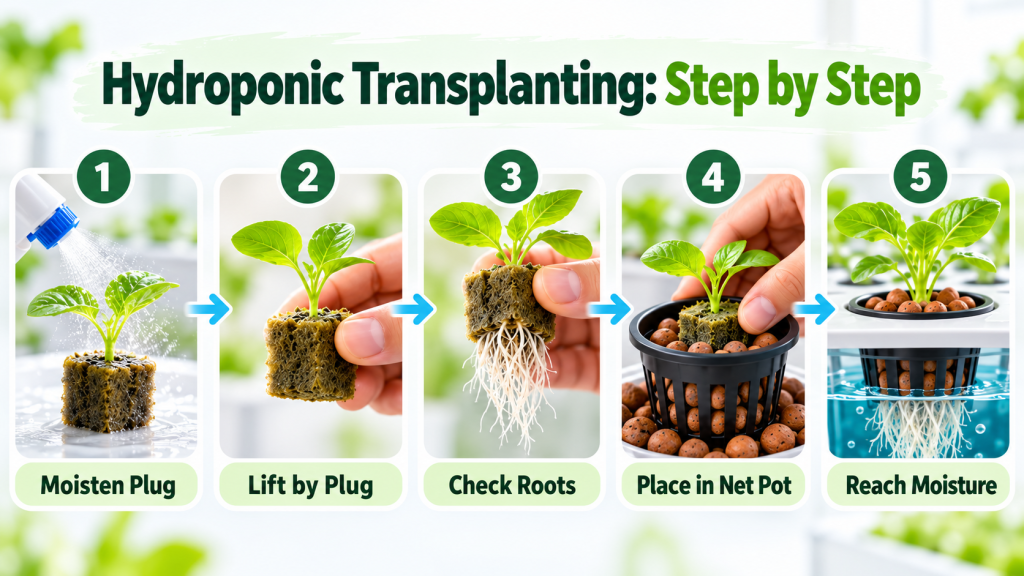
Step-by-Step Guide to Transplanting Hydroponic Plants
1. Moisten the Starter Plug
A slightly moist starter cube holds together better than a completely dry one. However, avoid soaking it until water is dripping from it.
Moisten it shortly before transplanting if necessary.
2. Lift the Seedling by the Plug
Never yank a hydroponic seedling upward by its stem.
Instead, lift the entire starter plug or cube. If seedlings share a propagation tray, separate them slowly so you do not tear roots that have grown together.
3. Inspect the Roots
Healthy young hydroponic roots normally look pale and firm.
Remove any loose dead material you can easily identify, but avoid unnecessary root pruning. The goal is to preserve as much healthy root tissue as possible.
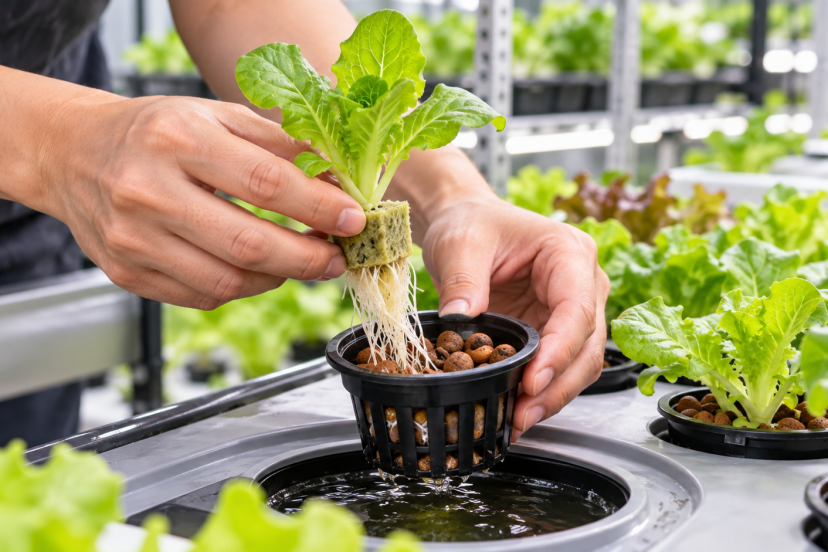
4. Place the Plant in the Net Pot
Set the starter cube in the center of the net pot.
Do not bury the stem deeply. The crown of the plant should remain above the wettest section of the growing medium.
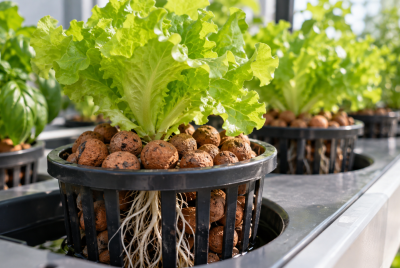
Add rinsed clay pebbles around the cube if additional support is needed. A good net pot gives roots plenty of openings through which they can reach the nutrient solution. This guide to using hydroponic net pots effectively explains positioning and water-level considerations in more detail.
5. Check Root Access to Moisture
Young roots must be able to reach moisture without drowning the entire starter cube.
In DWC, bubbles and splashing can keep the bottom of the plug damp until the roots grow into the reservoir.
In NFT, position the seedling so emerging roots can reach the thin stream of nutrient solution.
For Kratky systems, the lowest roots or bottom portion of the starter medium should initially have access to moisture. As the water level falls, an air gap develops beneath the plant.
Transplanting Into Different Hydroponic Systems
Once you transplant hydroponic plants into their final system, root placement and moisture access become especially important during the first few days.
Deep Water Culture
DWC is forgiving because the reservoir provides a large supply of water and nutrients.
At first, keep the solution high enough that bubbles from the air stone help moisten the lower part of the starter plug. Once roots extend into the solution, the water level can sit lower so part of the root system has access to oxygen.
Nutrient Film Technique
NFT requires more careful positioning.
The roots need to reach the shallow nutrient stream running through the channel. If a newly transplanted seedling sits too high, its short roots may dry before reaching the solution.
Check new transplants frequently during their first day.
Kratky Hydroponics
The Kratky method has no pump, so initial water placement matters.
The roots need early access to solution, but the entire net pot should not remain submerged. As plants consume water, the falling reservoir level creates an oxygen-rich zone for the upper roots.
How to Reduce Hydroponic Transplant Shock
Some temporary slowdown after transplanting is normal.
You can reduce stress by minimizing root disturbance, keeping temperature stable, maintaining suitable humidity, and avoiding sudden changes in light intensity.
Do not assume that a slightly wilted plant needs stronger nutrients. Adding extra fertilizer to an already stressed root system can make matters worse.
Give the plant time to establish.
Healthy new root growth is a more useful sign of recovery than the appearance of one older leaf.
Common Transplanting Mistakes
One of the biggest mistakes is waiting until seedlings become severely root-bound. Tangled roots are difficult to separate without damage.
Another problem is burying starter cubes too deeply or leaving them constantly saturated. The root zone needs both moisture and oxygen.
Other common mistakes include using dirty equipment, handling seedlings by the stem, making sudden nutrient-strength changes, exposing freshly transplanted plants to intense heat, and allowing short roots to dry before they reach the nutrient stream.
A careful five-minute transplant can save several days of plant stress.
Best Products for Transplanting Hydroponic Plants
1. AC Infinity 3-Inch Heavy-Duty Net Cups
These reusable net pots work well for many DWC, Kratky, and DIY hydroponic setups. Their open design gives roots room to grow through the cup while clay pebbles keep the plant supported.
2. Hydro Crunch Expanded Clay Growing Media
Expanded clay pebbles are useful around starter cubes because they stabilize plants without compacting tightly around the roots. Wash them well before adding them to the system to clear away loose dust and debris.
3. General Hydroponics FloraSeries
FloraMicro, FloraGro, and FloraBloom form a three-part nutrient system that lets growers adjust nutrition as plants develop. Current product information identifies the system for hydroponic use across multiple growing methods.
4. VIVOSUN Digital pH and TDS/EC Meter Kit
Checking nutrient strength and pH is much more reliable than guessing from fertilizer quantities alone. A meter kit is particularly helpful after transplanting because young roots can react quickly to extreme conditions. VIVOSUN’s meter combination is also currently listed among hydroponic equipment recommendations.
5. Root Riot Plant Starter Plugs
Root Riot-style starter plugs make seedling transfers easier because the plant can move with the plug rather than having its roots pulled free. They are commonly used for propagation before plants move into net pots or larger hydroponic systems.
Conclusion
A successful transplant should feel uneventful: the roots stay intact, the plant settles in, and new growth follows without much disruption. Once you understand when seedlings are ready and how to match root placement to your system, the process becomes much more straightforward. With a little care, you can transplant hydroponic plants confidently and give them a strong start in their final growing setup.
FAQs
Can you transplant hydroponic plants into another hydroponic system?
Yes. Plants can move between compatible hydroponic systems as long as you protect their roots and provide immediate access to water, nutrients, and oxygen.
How big should hydroponic seedlings be before transplanting?
Look for a sturdy seedling with several true leaves and visible root development. Do not wait until the roots become heavily tangled or the plant outgrows its starter cube.
Should roots touch the water after transplanting?
It depends on the system. DWC roots eventually grow directly into the nutrient solution, while NFT roots contact a shallow flowing film. Young seedlings must still have reliable access to moisture before their roots become long enough.
Can you transplant from soil to hydroponics?
Yes. Carefully remove as much soil as practical, rinse the roots gently, and transfer the plant into a clean net pot. Expect a longer adjustment period than you would with hydroponically started seedlings.
How long do hydroponic plants take to recover after transplanting?
Minor stress may last a few days. If wilting continues, inspect water access, root condition, temperature, pH, nutrient strength, and oxygenation rather than automatically adding more fertilizer.