Tips For Growing Hydroponic Monstera
We may earn a commission for purchases made using our links. Please see our disclosure for more details.
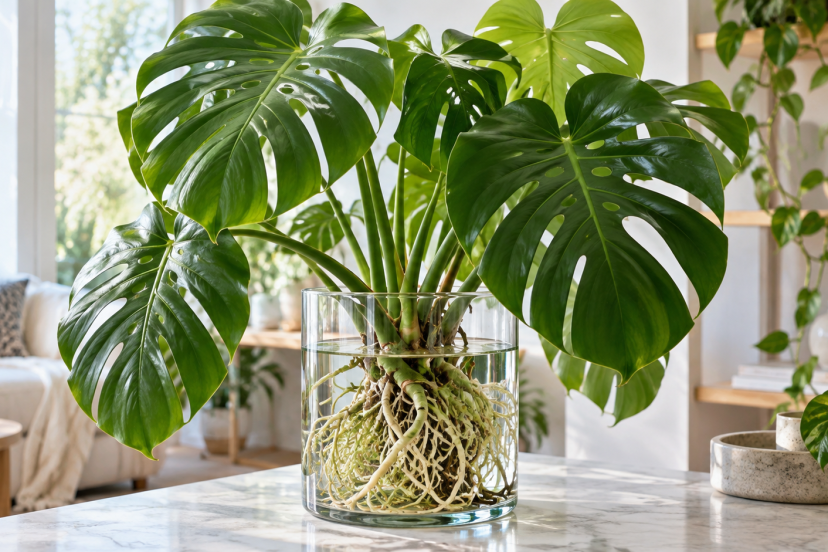
Growing a Hydroponic Monstera can make plant care cleaner, more controlled, and surprisingly satisfying. Instead of guessing when soil is dry enough to water again, you can see what is happening around the roots and manage moisture more directly.
Monstera deliciosa also adapts well to soilless growing. You can keep it in water or use a semi-hydroponic medium such as LECA. However, success depends on more than dropping the roots into a vase. Oxygen, nutrients, water quality, light, and root health all matter.
Here is how to give your Monstera a strong start.
What Is a Hydroponic Monstera?
A Hydroponic Monstera grows without traditional potting soil. Its roots receive water and dissolved nutrients directly, either from a reservoir or through an inert growing medium.
There are two common approaches.
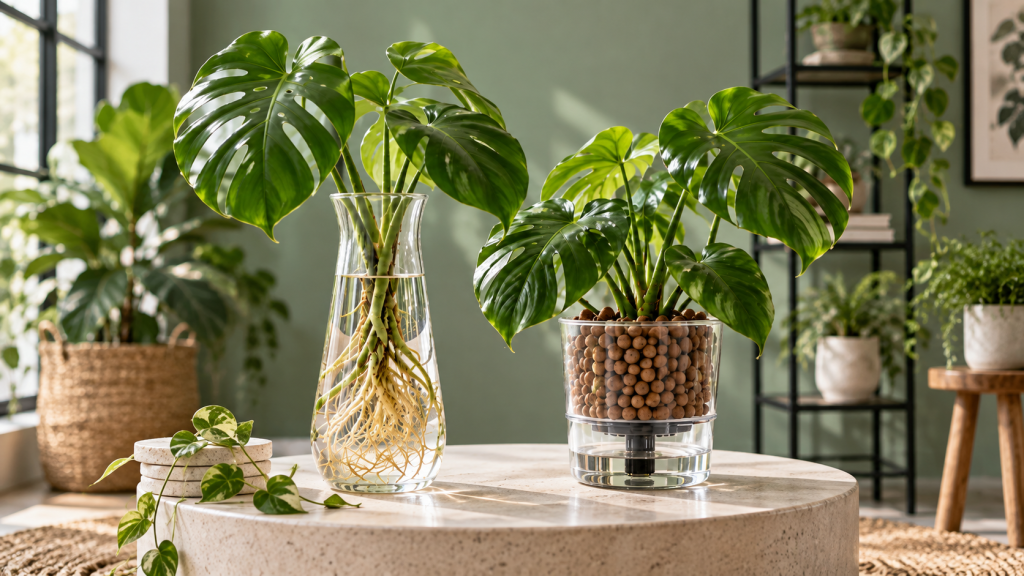
Full water culture keeps some or most roots in nutrient solution. Semi-hydroponics uses a material such as LECA to hold the plant upright while drawing moisture from a small reservoir below.
For large Monsteras, semi-hydro often feels easier to manage because the clay pebbles provide physical support and create air spaces around the root system.
If you want to understand the medium in more detail, this guide to using hydroponic clay pebbles explains how LECA handles moisture, drainage, and aeration.
Start With a Healthy Plant
Avoid converting a badly stressed Monstera and hoping hydroponics will rescue it. Start with a reasonably healthy plant that has firm stems and a functional root system.
You can also begin with a cutting. The cutting must contain a node because a leaf and petiole alone cannot develop into a new Monstera plant. University of Minnesota Extension recommends taking stem material with a node and notes that Monstera cuttings can root in plain water. Its detailed Monstera propagation guide is a useful reference for identifying viable cuttings.
When converting an established plant from soil, remove as much potting mix from the roots as reasonably possible. Work slowly. Rinsing several times is safer than aggressively scraping delicate roots.
Choose Between Water Culture and LECA
A jar of water is the simplest setup, particularly for a young cutting. You can also easily see new root growth as it happens.
Long-term growth is a little different. A mature Monstera becomes heavy, and its expanding root system needs both support and oxygen.
LECA is useful here. The porous clay balls hold some moisture while leaving large air gaps around the roots. They are also reusable after proper cleaning. University of Minnesota lists LECA as a suitable Monstera rooting medium because of its drainage properties.
For many home growers, a slotted inner pot filled with LECA and placed inside a reservoir pot offers a practical balance between hydration and airflow.
Keep the Water Level Below the Stem
One of the easiest mistakes is filling the container too high.
The stem and crown do not need to sit underwater. Constantly soaking these areas encourages decay. In a LECA setup, keep the reservoir toward the lower portion of the container so moisture can move upward while much of the root zone still receives air.
With direct water culture, avoid treating the container like a completely full vase. Leaving part of the root system exposed to humid air can improve oxygen access.
Check the roots whenever you refresh the reservoir. Healthy new roots usually appear cream, white, or light tan and feel firm. Dark, mushy roots with an unpleasant smell suggest trouble.
Pay Attention to pH and Nutrient Strength
Plain water may work while a cutting develops its first roots, but it does not provide complete nutrition indefinitely.
Once your Hydroponic Monstera settles in, use a complete fertilizer made for hydroponic growing. Start conservatively rather than mixing the strongest concentration on the label. Monstera is a foliage plant, and more fertilizer does not automatically mean faster growth.
Most hydroponic crops perform well around pH 5.5 to 6.5, according to University of Missouri Extension. If the pH moves too far from the ideal range, the plant may struggle to absorb some nutrients properly, even when those nutrients are already in the water. Missouri Extension’s hydroponic nutrient guidance also explains why both pH and electrical conductivity matter.
For more hands-on guidance, see this explanation of monitoring pH and EC in hydroponic nutrients.
Give the Roots Enough Oxygen
Water alone is not the problem in hydroponics. Low oxygen is.
Roots need oxygen for normal respiration and nutrient uptake. University of New Hampshire Extension explains that hydroponic systems must provide oxygen to the root zone and that stationary water systems often benefit from an air pump and air stone. Its home hydroponics guide explains root-zone aeration in more detail.
If you grow your Monstera directly in a deeper reservoir, adding gentle aeration is worthwhile.
LECA systems usually rely more on the air spaces within the medium, so constant bubbling is not always necessary.
Give Your Monstera Bright, Indirect Light
Hydroponics does not change the basic light requirements of Monstera.
Choose a well-lit location where your Monstera gets plenty of gentle daylight without harsh sun hitting the leaves directly. If it has been growing in lower light, introduce stronger sunlight gradually to prevent leaf scorch. Large Monstera leaves can scorch when light increases too quickly.
Insufficient light creates another problem: the plant may survive but produce slower growth, smaller leaves, and fewer dramatic fenestrations. University of Wisconsin notes that inadequate light can limit the characteristic perforations associated with mature Monstera foliage.
A grow light can help when natural window light is limited.
Refresh the Reservoir Regularly
Do not continually top up the same nutrient solution for months.
Water and nutrients are absorbed by plants at different speeds. Meanwhile, mineral salts can accumulate and the pH can drift.
Periodically empty the reservoir, rinse it, and mix fresh nutrient solution. Between full changes, you can add plain water when evaporation or plant uptake lowers the level significantly.
There is no universal replacement schedule for every home because reservoir size, temperature, plant size, and light all affect water use. The better habit is to inspect the water and roots regularly instead of relying only on the calendar.
Support the Plant as It Gets Larger
Monstera is naturally a climbing plant. Hydroponics does not remove that habit.
As leaves become larger, provide a sturdy stake, trellis, or other support. Make sure the container is heavy enough to remain stable as well.
Do not rely on a lightweight glass jar for a large mature plant. A top-heavy Monstera can quickly turn an attractive water display into a floor-cleaning project.
Watch for Common Hydroponic Monstera Problems
Yellow leaves can come from several causes, including weak light, excessive fertilizer, nutrient imbalance, damaged roots, or poor oxygenation. Check the entire setup before adding more nutrients.
Brown root tips deserve attention too. Remove truly soft or decaying material with clean scissors, then improve aeration and refresh the solution.
Algae usually appears when light reaches nutrient-rich water. An opaque reservoir or decorative outer pot can reduce light exposure without affecting the plant.
Finally, expect some adjustment after moving a soil-grown Monstera into hydroponics. Soil-adapted roots and water-adapted roots are not identical, so temporary leaf stress does not automatically mean the conversion has failed.
Recommended Products for Growing Hydroponic Monstera
General Hydroponics Flora Series
The three-part FloraMicro, FloraGro, and FloraBloom system lets you adjust nutrient ratios rather than relying on ordinary soil fertilizer. For a Monstera, begin with a mild concentration and increase only if the plant responds well.
Legigo LECA Clay Pebbles
These expanded clay pebbles provide a reusable medium for semi-hydro growing. Their varied pebble size creates useful air spaces around Monstera roots. Rinse them thoroughly before use.
VIVOSUN Digital pH Meter
A digital meter makes it much easier to catch pH drift before nutrient availability becomes a problem. Calibrate it regularly rather than assuming every reading is automatically accurate.
SANSI 36W Grow Light Bulb
This full-spectrum bulb is useful when your Monstera sits far from a bright window or growth slows during darker months. Adjust distance based on the plant’s response rather than placing a strong lamp directly against foliage.
Tetra Whisper Air Pump
For a Monstera growing directly in a larger water reservoir, an aquarium air pump paired with an air stone can improve water movement and oxygenation around submerged roots.
Conclusion
Growing a Hydroponic Monstera is less about keeping roots permanently wet and more about balancing water, oxygen, nutrients, and light. Start with clean, healthy roots, keep the stem above the reservoir, use a complete but mild nutrient solution, and monitor pH instead of guessing. LECA makes the process especially manageable for larger plants because it combines moisture with physical support and airflow. Once the plant adapts, routine care becomes fairly straightforward: watch the roots, refresh the reservoir, maintain good light, and let the plant tell you when something needs adjusting.
FAQs
Can Monstera grow permanently in water?
Yes, Monstera can be maintained in water or a hydroponic system long term, but plain water alone is not enough for sustained growth. The plant eventually needs mineral nutrients and adequate oxygen around its roots.
Is LECA better than water for Monstera?
Neither method is automatically better, but LECA is often easier for large plants. It supports the root system and stem while maintaining air spaces around the roots.
What pH is best for a Hydroponic Monstera?
A practical starting range is roughly 5.5 to 6.5, which falls within the commonly recommended range for hydroponic nutrient solutions. Monitor the plant rather than chasing tiny daily fluctuations.
When should I refresh the water in my hydroponic Monstera setup?
Refresh the reservoir regularly and sooner if the solution develops an odor, heavy mineral buildup, algae, unusual cloudiness, or significant pH drift. Larger plants and smaller reservoirs usually need closer monitoring.
Can I move a soil-grown Monstera directly into LECA?
Yes. Remove as much soil from the roots as possible, trim genuinely rotted roots, rinse the LECA, and keep the initial nutrient solution mild. Some temporary stress is normal while the root system adjusts to the new environment.