How To Make A DIY Hydroponic Nutrient Solution
We may earn a commission for purchases made using our links. Please see our disclosure for more details.
If you want more control over your grow and lower long-term costs, learning how to make a diy hydroponic nutrient solution is one of the smartest steps you can take. Instead of relying entirely on commercial bottles, you can mix your own nutrients with precision, flexibility, and confidence.
Hydroponic enthusiasts often reach a point where they ask: What’s actually inside these nutrient blends? Once you understand plant nutrition, the mystery disappears. Even better, mixing your own formula gives you the power to adjust nutrient ratios based on growth stage, plant type, and performance goals.
In this guide, I’ll walk you through everything step by step — from understanding essential nutrients to exact mixing instructions, growth-stage adjustments, and common mistakes to avoid.
Let’s dig in.
Understanding What Plants Really Need
In soil gardening, microbes help regulate nutrients. In hydroponics, however, your nutrient solution becomes the plant’s entire food source. That means balance matters.
Plants require three main categories of nutrients:
Macronutrients (Primary)
- Nitrogen (N) – Promotes leaf growth
- Phosphorus (P) – Supports root and flower development
- Potassium (K) – Strengthens overall plant health
Secondary Nutrients
- Calcium
- Magnesium
- Sulfur
Micronutrients
- Iron
- Manganese
- Zinc
- Copper
- Boron
- Molybdenum
Although micronutrients appear in small amounts, deficiencies can cause major growth problems.
A peer-reviewed study published in Scientia Horticulturae found that imbalanced calcium and nitrate ratios in hydroponic nutrient solutions disrupted normal root development and reduced plant growth performance, even when other environmental factors such as light and temperature remained stable. This reinforces a critical point for hydroponic growers: nutrient balance is not optional. Even small deviations in ratios can limit biomass production and ultimately reduce yield potential.
Hydroponics removes guesswork from soil variability — but it requires you to mix precisely.
Ingredients for a DIY Hydroponic Nutrient Solution
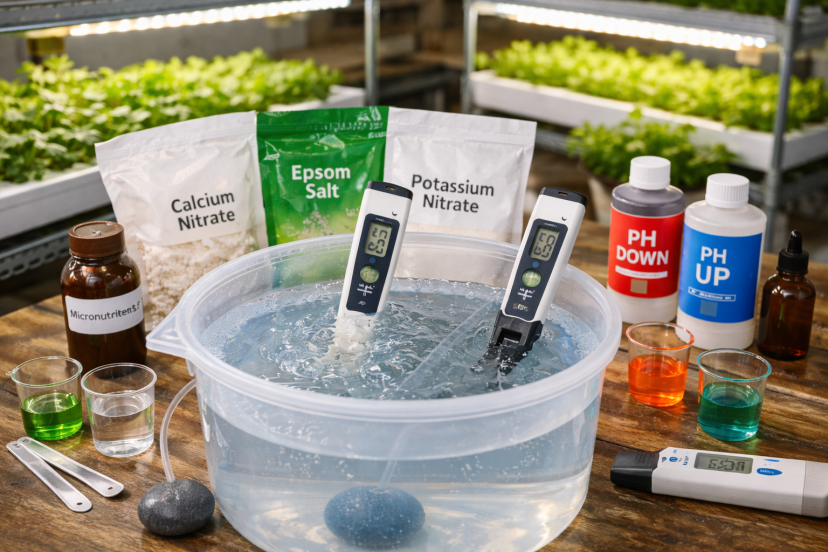
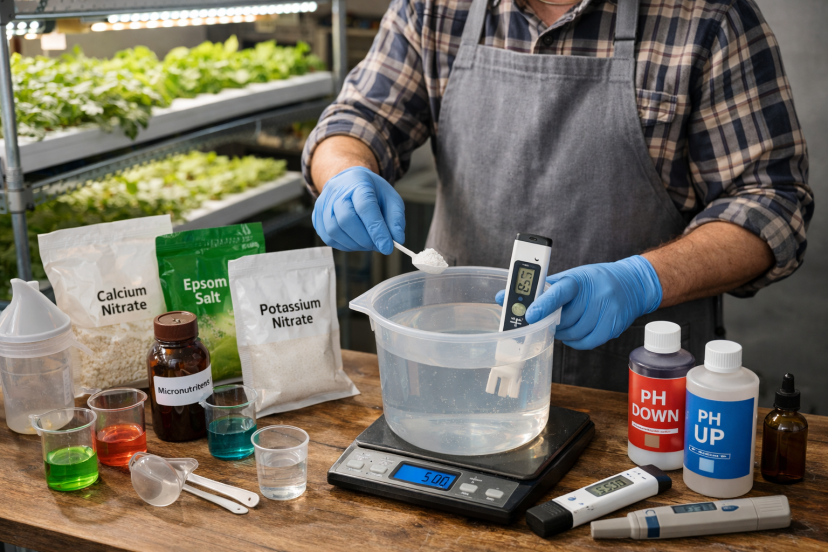
To create a balanced DIY hydroponic nutrient solution, you’ll need specific salts that supply essential nutrients in measurable form.
Core Nutrient Salts
- Calcium Nitrate
- Potassium Nitrate
- Monopotassium Phosphate
- Magnesium Sulfate (Epsom Salt)
- Chelated Micronutrient Mix
These components form the backbone of most commercial nutrient blends.
Tools for Accurate Mixing
Precision separates thriving plants from struggling ones.
You’ll need:
- Digital gram scale
- pH meter
- EC (Electrical Conductivity) meter
- Clean mixing containers
- Distilled or reverse osmosis (RO) water
Tap water can contain dissolved minerals that interfere with nutrient balance, so starting with clean water ensures accuracy.
Step-by-Step: How To Make A DIY Hydroponic Nutrient Solution
Let’s get practical.
Step 1: Begin With Clean Water
Start with distilled or RO water. Ideally, your base water should measure below 0.2 mS/cm EC.
Clean water gives you full control over final nutrient strength.
Step 2: Prepare Separate Stock Solutions
Never mix calcium nitrate directly with phosphates or sulfates in concentrated form. This creates precipitation, which locks nutrients out.
Instead, prepare two separate solutions:
Solution A
- 5 grams Calcium Nitrate per gallon of water
Solution B
- 2 grams Potassium Nitrate
- 1 gram Monopotassium Phosphate
- 2 grams Magnesium Sulfate
Dissolve each solution fully before combining them in your reservoir.
Step 3: Add Micronutrients
Add chelated micronutrients according to manufacturer recommendations, typically around 0.5–1 gram per gallon.
Stir thoroughly. Even distribution prevents localized deficiencies.
Step 4: Measure and Adjust EC
After mixing, measure Electrical Conductivity.
General EC targets:
- Leafy greens: 1.2–1.8 mS/cm
- Herbs: 1.4–2.0 mS/cm
- Fruiting plants: 2.0–2.5 mS/cm
If EC runs high, dilute with water. If low, increase nutrients gradually.
Step 5: Adjust pH
Hydroponic systems require a pH range between 5.5 and 6.5.
When pH drifts beyond this range, plants struggle to absorb key nutrients effectively. For example, iron absorption drops quickly when pH rises above 6.5.
Adjust the pH gradually using pH down or pH up products, and add them in small amounts to avoid overshooting. Add small amounts, stir, wait 10–15 minutes, then recheck.
Stability matters more than perfection.
Adjusting Nutrients for Growth Stages
Plants don’t require the same nutrient ratios from seedling to harvest.
Seedling Stage
- Lower EC (0.8–1.2)
- Reduced nitrogen
- Gentle nutrient exposure
Vegetative Stage
- Increase nitrogen
- Maintain moderate EC
- Focus on leaf and stem strength
Flowering and Fruiting Stage
- Increase potassium and phosphorus
- Reduce nitrogen slightly
- Maintain stable calcium levels
A 2020 review in Agronomy found that stage-specific nutrient adjustments can significantly increase hydroponic lettuce yield compared to static nutrient programs.
In short, customization boosts performance.
Recommended Tools for Precision
If you want consistency, these tools make a noticeable difference:
- Apera AI209 Waterproof pH Tester – Reliable and accurate.
- Bluelab EC Pen – Quick EC monitoring.
- Greater Goods Precision Scale – Measures in grams accurately.
- General Hydroponics pH Control Kit – Safe adjustments.
- Hydroponic Nutrients – Balanced micronutrients.
These tools prevent overfeeding and nutrient lockout.
DIY Nutrients vs Commercial Nutrients
Many hydroponic enthusiasts eventually compare costs.
DIY Advantages
- Lower cost per gallon
- Customizable nutrient ratios
- Scalable for larger grows
Commercial Advantages
- Convenience
- Pre-balanced formulas
- Simpler for beginners
If you’re new and prefer simplicity, complete hydroponic kits often include structured feeding schedules and pre-measured nutrients.
However, once you gain confidence, mixing your own nutrients provides more flexibility.
Common Mistakes to Avoid
Even seasoned growers slip up from time to time.
- Mixing dry salts together
- Ignoring pH drift
- Skipping EC checks
- Reusing old nutrient solution too long
- Overfeeding to “speed up” growth
Hydroponics rewards consistency and patience.
How Frequently Should You Refresh the Nutrient Solution?
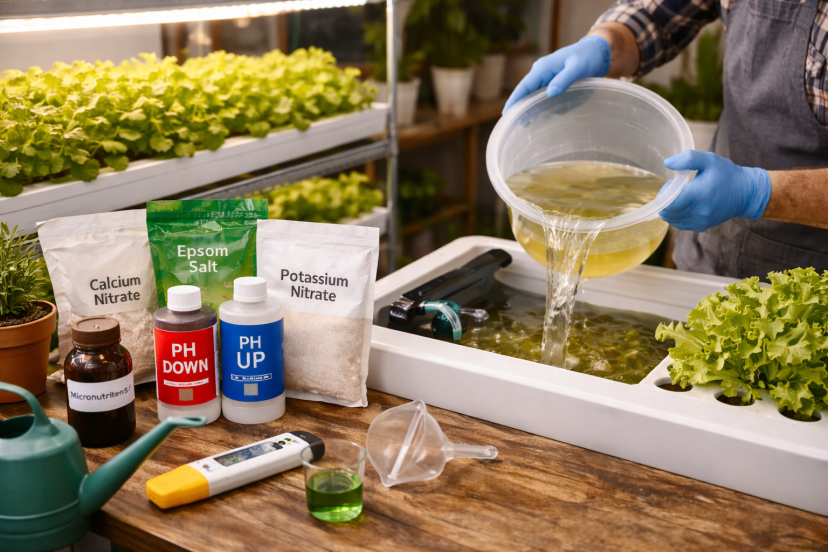
Most systems benefit from a full nutrient change every 1–2 weeks.
Between changes:
- Top off with water
- Monitor EC daily
- Adjust pH as needed
Plants absorb nutrients at different rates. Over time, imbalance occurs. Replacing the solution restores equilibrium.
Troubleshooting Nutrient Issues
Even with careful mixing, problems can appear.
Yellowing Leaves
Likely nitrogen or iron deficiency. Check pH first.
Brown Leaf Edges
Often potassium imbalance or nutrient burn.
Blossom End Rot
Usually calcium deficiency or inconsistent watering.
A review in The Journal of Plant Nutrition emphasizes that calcium availability depends not only on concentration but also on stable pH and proper transpiration.
In hydroponics, correction happens quickly once you identify the issue.
Cost Breakdown of DIY Hydroponic Nutrients
Let’s talk numbers.
A single batch of nutrient salts can last months for small growers. When compared to branded nutrient bottles, DIY mixing can reduce costs by 30–50% over time.
That said, beginners may appreciate commercial blends while learning the basics.
Both approaches work. The difference lies in control.
Why DIY Nutrient Mixing Improves Your Skills
Making your own DIY hydroponic nutrient solution forces you to understand plant nutrition. Over time, you start to recognize deficiency patterns, monitor EC more closely, and fine-tune adjustments based on each growth stage.
Instead of reacting to problems, you prevent them.
That level of awareness transforms average growers into confident hydroponic enthusiasts.
Conclusion
Learning how to make a DIY Hydroponic Nutrient Solution gives you more than cost savings. It gives you control. Once you understand nutrient balance, EC levels, and pH management, your plants respond with stronger roots, healthier leaves, and higher yields. Start small. Measure carefully. Observe daily. Hydroponics rewards precision, patience, and curiosity. If you’re ready to move beyond pre-mixed bottles and take ownership of your grow, this is your next step.
FAQs
1. Can I use regular garden fertilizer in hydroponics?
No. Soil fertilizers often lack balanced micronutrients and may clog hydroponic systems.
2. What pH level works best for hydroponic plants?
Between 5.5 and 6.5 for most plants.
3. How often should I check EC?
Check daily if possible. Plants consume nutrients unevenly.
4. Is Epsom salt safe in hydroponics?
Yes. Magnesium sulfate supports chlorophyll production when used correctly.
5. Is DIY nutrient mixing safe for beginners?
Yes, as long as you measure carefully and monitor EC and pH consistently.